
Route Report: Groover 5.8, Laurel Knob
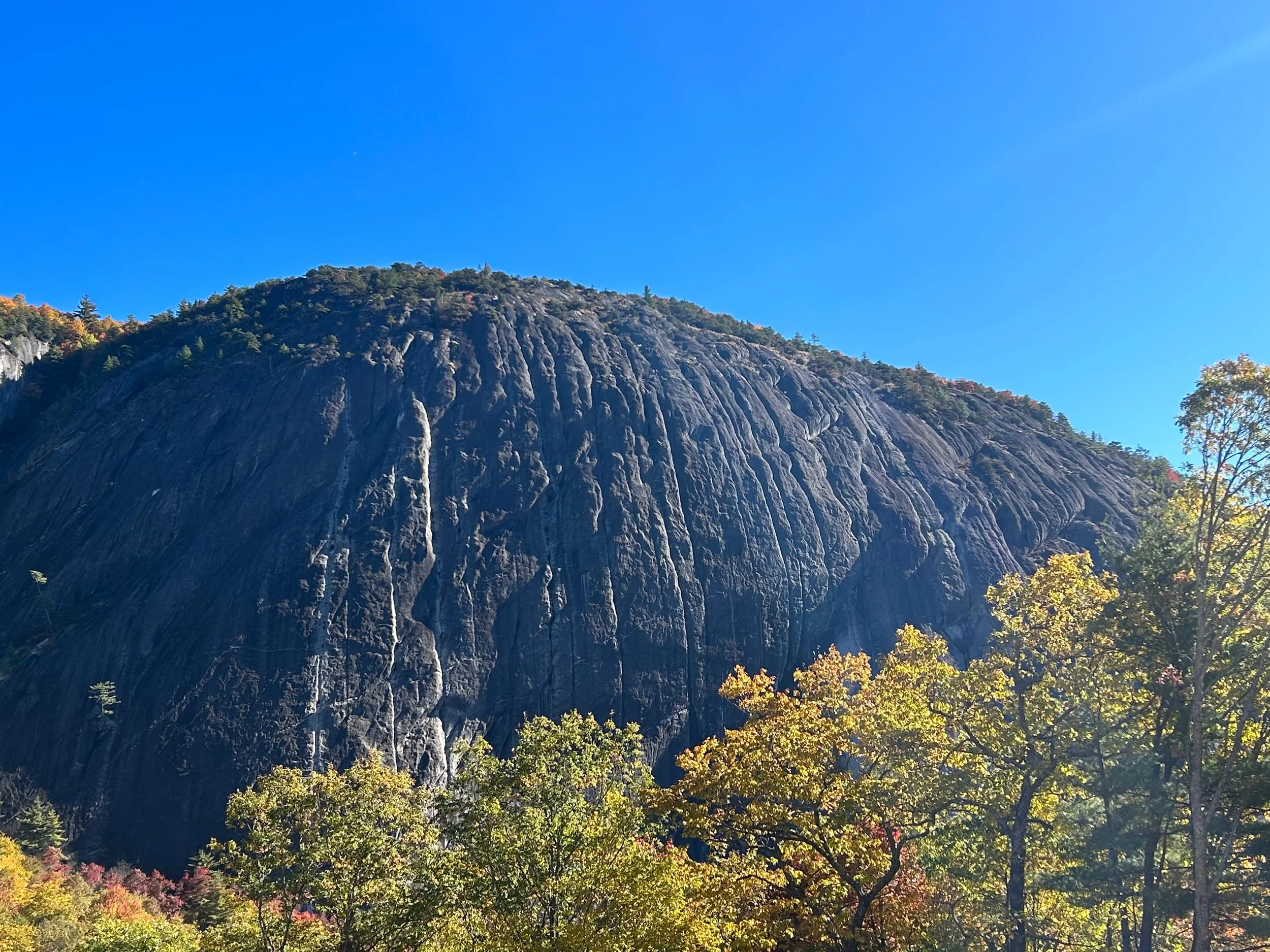
Laurel Knob, man. Laurel Knob.
We recently had the good fortune of a Private Guided Trip to climb Groover at Laurel Knob. Laurel Knob is the tallest rock face on the East Coast of the United States and rises to a height of 1200’ from the base of the cliff to the top. Its BIG!
Groover is an amazing rock climb that follows mostly moderate terrain on the left side of the cliff. First climbed in the Early 1980’s by Jeep and Julia Gaskin.
Many things make climbing at Laurel Knob a challenge including the approach. Paul and I met at the trailhead for Panthertown valley at 6:30am on out climbing day. The approach is about 3.5 miles and goes through some really nice trails as you approach the base of the cliff. For time plan for the day we budgeted 2 hours on the approach and made the hike in about 1:40 total time with breaks.
On the final descent to the base of the wall you go down a series of switchbacks on the right side of the cliff. As you descend the cliff comes into view and you start to realize just how big it really is. The wall soars above you and the way the top of the wall rolls over and goes out of sight makes it seem like there is no summit.
Once at the base of the route on the left side of the cliff you can look up and see a large pine tree that marks the top of the first pitch. This tree has some cord around it and serves as the last easy place to bail from the route until you climb several more very long pitches up the wall.
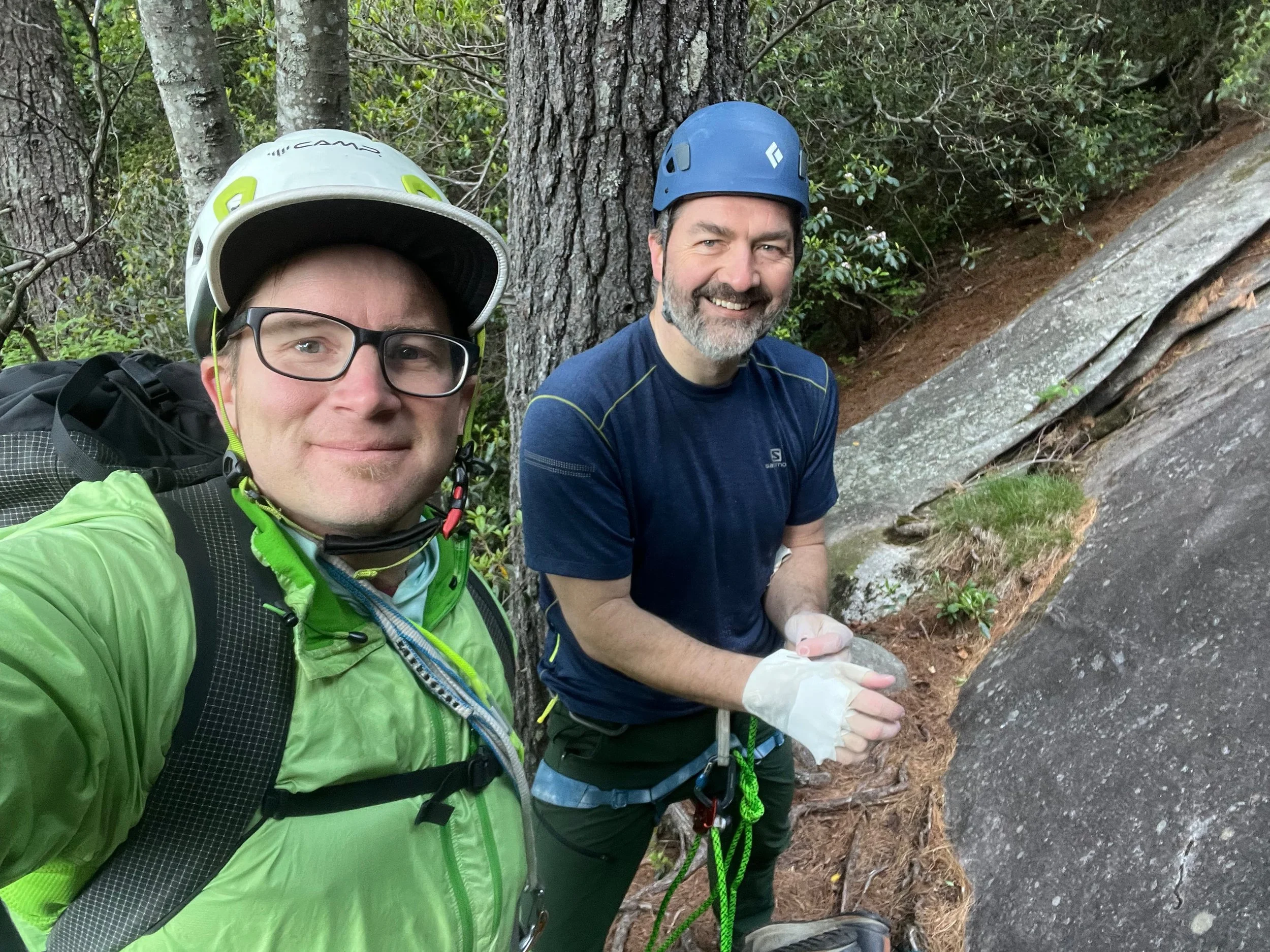
The base of the route is marked by a large tree.
The climbing is fairly straightforward slabbing with adequate protection opportunities. For this outing the rack I chose was from small TCU size to a 4 Camelot with some doubles in a .3 to 2 Camalot. We also brought 2 ropes, a Edelweiss Spirit (8.8mm) and an Edelrid Rap line (6mm). Even with the new walkoff option having 2 ropes makes a lot of sense in the event that you need to retreat for weather or other emergencies. I would consider 2 ropes nearly mandatory for climbing at Laurel.
The first few pitches are easy enough but all of the climbing could be considered around the 5.7 grade. There’s some definite sections that make the grade but there are also sections where you are slabbing your way up at an easier grade. Mostly very chill and very long pitches. You should plan to stretch your 60 meter rope out several times until you reach the 4th pitch.
At the 4th pitch things get a lot more interesting. This pitch features a hard to follow traverse and climbing far out from your protection. The pitch begins easy enough by placing a high piece of protection and then starting a rightward traverse. You will want to traverse until you are in the second of 2 water grooves. The first water groove is mossy and uninviting. Once you reach this water groove you will have a few more bolts for protection. Stay in the groove and keep moving up and follow it to a good belay stance on natural gear.
From here there are a few options to continue the route. The original line followed a groove that goes straight up to the left from here. The line that we chose to take continued to the right for 3 more pitches until you can reach the new walkoff descent.
Up until recently any climbing done on Laurel required you to descend by rappelling back down the face and then making your way back up the switchbacks that you came down on the approach. This was a real pain and added a lot of complexity to the day because on a route like Groover you were not rappelling down the same way that you climbed up. Over the years many epics ensued. On the rappel stations there were instructions given for how to find the next rappel station as you quested downward in the seemingly endless sea of granite. Even with efficient transitions the 5 or 6 double rope rappels required to descend the face was a major hurdle that would take several hours.
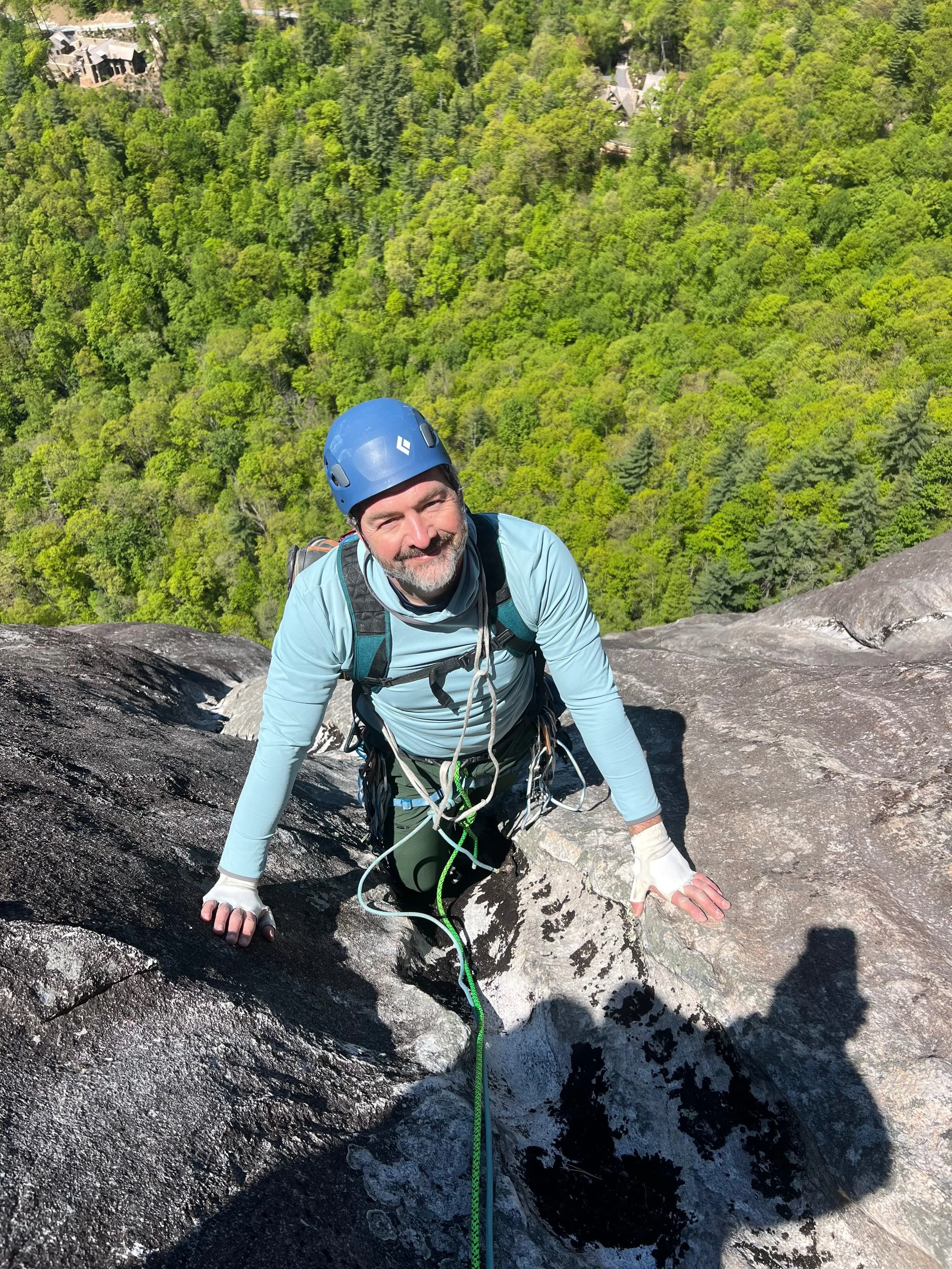
At the top of the 4th pitch.
With the advent of the new walkoff you will want to climb an additional easy pitch 7 seven to reach the top of the mountain. The walkoff is marked with orange signage and is really easy to follow thanks to some volunteers from the Carolina Climbers Coalition. This avoids a lot of the hassle of rappelling and saves about 2 hours of time overall to the day. Very thankful this option now exists.
While the long approach and the soaring cliff give the impression of being deep in the wilderness, you’re not. A large residential neighborhood sits at the base of the cliff and sprawls across the surrounding hillsides. We were there on a Sunday and had the climb to ourselves, but the solitude came with a soundtrack: a chorus of chainsaws from yard work echoed up the face. It’s disappointing, especially when you expect only wind and birds, but there’s little to be done — the cliff is bordered by private property. If you go expecting a truly remote experience, you’ll likely be let down; if you go for the climbing itself, the rock and routes still deliver. Plan for some noise, respect the homeowners’ land, and enjoy the climb for what it is rather than what you wished it to be.
All in all climbing at Laurel Knob is a real treat and is a great objective in and of itself. It requires a long approach, a really big climb, and logistics planning more akin to climbs found in the Western US. If you want to climb Groover or other routes at Laurel Knob we are happy to help you with beta or setting up a guided day.